Tuesday, May 30, 2017
Pig Dissection
I think the relate and review for the pig dissection would be "What is the structure and function of the different body parts in a pig?" During the course of this pig dissection, we needed to identify and say what the function of each part is. The pig dissection relates to this class because in the last unit, we have learned about the different body systems of a human. A pig and human are very similar in anatomy because we are both mammals because of the traits we learned in the previous unit. For me, my favorite of the dissection was cutting the skin open to see all the body parts. I cannot really say why, but it felt satisfying when I cut open the skin and see the organs inside the pig. I am not grossed out by the organs and I find it interesting. I also liked looking inside the pig and trying to identify the body parts and what they look like. I used the tools and poked around in the pig to see what is inside. The pig dissection was definitely a valuable experience. It is not every day where you get to dissect a pig. Also, since this is a biology class and biology is the study of life and living organism, it is important to look at an actual living organism. Learning about something is one thing, but it is another thing to actually look at the thing in real life. For the pig dissection, we were asked to identify the structure and function of the pig with a video tutorial and that video my group and I made can be viewed here via YouTube.

Friday, May 19, 2017
20 Time Individual Reflection
For my 20 Time project, I decided to design an experiment to test the benefits of taking a nap. I took on this challenge as my project because I am interested in how much sleep impacts everybody's lives and how productive naps can be. Initially, I set a goal to run an design an experiment and gather data so I could analyze the impact of naps. By the end of the project, I wanted to gather enough data to safely conclude how beneficial naps are. Through the course of this project, I focused mainly on collecting evidence to make a conclusion, but along the way, there are many situations in which I grow and improve as a student. After collecting my evidence, I could potentially tell others about my experiment and they could benefit from what I told them.
At the start of this project, my plan consisted of designing an experiment that follows the scientific method. I would collect data, form a hypothesis, design and run an experiment, gather data, and form a conclusion. Knowing that I wanted to do this and the timeline of this project, I started researching as my first step. After researching enough and forming my hypothesis, I can now design an experiment. Next, I needed to find people that are willing to participate in my experiment. After a while, I needed to check on the people that ran my experiment and collect the data. This took the longest time because I needed to get a good number sample size to make a conclusion.
That was all my initial understanding. As always, nothing ever goes perfect so I needed to improvise. The first setback I had was designing the experiment. This, in my opinion, is the hardest step. Normally in labs, I am given instructions, but in this 20 Time project, I needed to design my own experiment. This took a while because I really needed to assess what I wanted to find out. Another setback I had during the course of this project was to get a good number of people to participate in my experiment. I needed to reach out to my friends and even my family and get as many people I can get to participate in my experiment. This took a long time because I needed to tell them about my experiment and ask if they were available to do it. Many of them said yes initially, but when I followed up, many of them said that they either did not have enough time or they forgot.


I did not only have setbacks and failures during the course of my project. Once I was assigned the project, I knew what I wanted to do. I wanted to do something related to sleeping and brain-related topics. I just needed to narrow my vision and compose an experiment that is plausible to complete on time. I also found analyzing the data a success. I like to very neat and organized so I created a Google Sheets and composed a table with all my data. Since I am a visual person, I made a graph to further analyze my data. After I collected my data and made charts, I could make a reasonable conclusion about what I think the data is trying to say.
Along the way of this project, I learned a lot about my topic I researched and also the various soft and process skills. I did gather enough data to make a conclusion, but as I went about my experiment, I learned a lot about designing an experiment, problem solving, and time management. I learned a lot about myself as I am finishing up such a non restricted project. The fact that 20 Time allows students to explore their interests lets them wander into their own interests and designing their own experiment, base on what they desire. Throughout this project, I learned more about myself and how I operate. I learned about making a strict timeline so I can get things done in a timely fashion.
If I were to start over, I would change the way I asked people to run my experiment. This took a long time, and I should have wrote it once and then copy and paste my messages to my peers. Instead, what I did was respond to each person with the same message, but I typed it up every time. This long process impeded how fast I got different people to participate in my experiment. After all I have done to learn about my topic, it is safe to say that I have gathered enough information to spread my knowledge on what I have discovered. I can share to my peers and they will take my advice for future references.
Tuesday, May 9, 2017
Unit 9 Reflection
Unit 9 taught me how to classify animals. The first essential question of this unit was "How is life organized?" Throughout the vodcast, I learned about different domains and kingdoms. Not only did I learn the various domain and kingdoms, I also learned about the structure of organization after that. Next comes the phylum, class, order, and so on. This unit taught me how to classify organisms. Some other essential questions are "How does a taxonomist determine the kingdom and domain that an organism belongs to?" and "How do defining characteristics of modern invertebrate phyla show increased complexity evolved in animal kingdom?'.


After learning about the various domains, kingdoms, and phylum and how they can group different organisms in a fairly organized manner, I still wonder about the "odd-ball" organisms. Mr. Orre mentioned that protists is kind of the miscellaneous group. In the world of science, there is never a right or wrong answer or even lines. There will always be some grey area that scientists debate and I wonder about those "odd-ball" organisms and I am interested in how they could possibly be classified.
During the course of this unit, I put a lot of effort into a presentation called What on Earth Evolved. During the lottery of choosing my organism, I chose the shark. During the course of my research, I found many interesting things about sharks that I did not know before. I studied their significant impact on Earth and their distinctive characteristics. After I spent a lot of time researching, I could dump all my information I gathered into a Google Slides Presentation, which is embedded below. Having made presentations before, I came into this project knowing that formatting presentations to make them aesthetically pleasing takes a lot of time. I tried to include little amounts of text per slide complemented by a picture that portrays the point I am trying to make. I also need to make sure to not forget to cite my source. After I finished my presentation, I now needed to practice presenting. I asked my dad for help because I knew that he is adept at speaking in front of large groups. I asked him if he could critique my presentation and he gave me a few pointers such as "Don't say umm, like, and so a lot or else it seems like your stalling." or "You're talking to fast." These pointers eventually gave me a direction to point my presentation before. Finally when I thought I was ready, I presented to my family to get practice speaking in front of people. This practice was really helpful because it made me get use to people staring at me.

It was the day of the presentation and I was presenting last. I was really anxious during the time of the presentations before me. Once it was my turn, I executed my presentation well, but I thought I spoke too fast and did not provide eye contact with enough of the audience. I started my presentation with a question, trying to involve the audience, and surprisingly, many different people started saying what they thought, which gave me confidence. I ended with a pun, which might have been funny.

Trying to assess my performance, I thought that having few bullets per slide was helpful because it did not overwhelm the audience and also gave me pointers to the things I wanted to say. I also thought pictures were nice to because it supported my point. At the end, I had four slides of Works Cited, which I did not like. For the future, I could make the font smaller to squeeze my links into a smaller space.
For the future, I should give myself more time to practice my presentation. Getting some practice helps because you know what you want to say and also you do not get too nervous in front of the audience. Also, I thought that I was speaking a little too fast, which I tend to do when I get nervous. In addition, I should have stood more assertively and projected my voice to sound confident.
It was the day of the presentation and I was presenting last. I was really anxious during the time of the presentations before me. Once it was my turn, I executed my presentation well, but I thought I spoke too fast and did not provide eye contact with enough of the audience. I started my presentation with a question, trying to involve the audience, and surprisingly, many different people started saying what they thought, which gave me confidence. I ended with a pun, which might have been funny.

Trying to assess my performance, I thought that having few bullets per slide was helpful because it did not overwhelm the audience and also gave me pointers to the things I wanted to say. I also thought pictures were nice to because it supported my point. At the end, I had four slides of Works Cited, which I did not like. For the future, I could make the font smaller to squeeze my links into a smaller space.
For the future, I should give myself more time to practice my presentation. Getting some practice helps because you know what you want to say and also you do not get too nervous in front of the audience. Also, I thought that I was speaking a little too fast, which I tend to do when I get nervous. In addition, I should have stood more assertively and projected my voice to sound confident.
Wednesday, April 19, 2017
Geological Timeline Individual Reflection
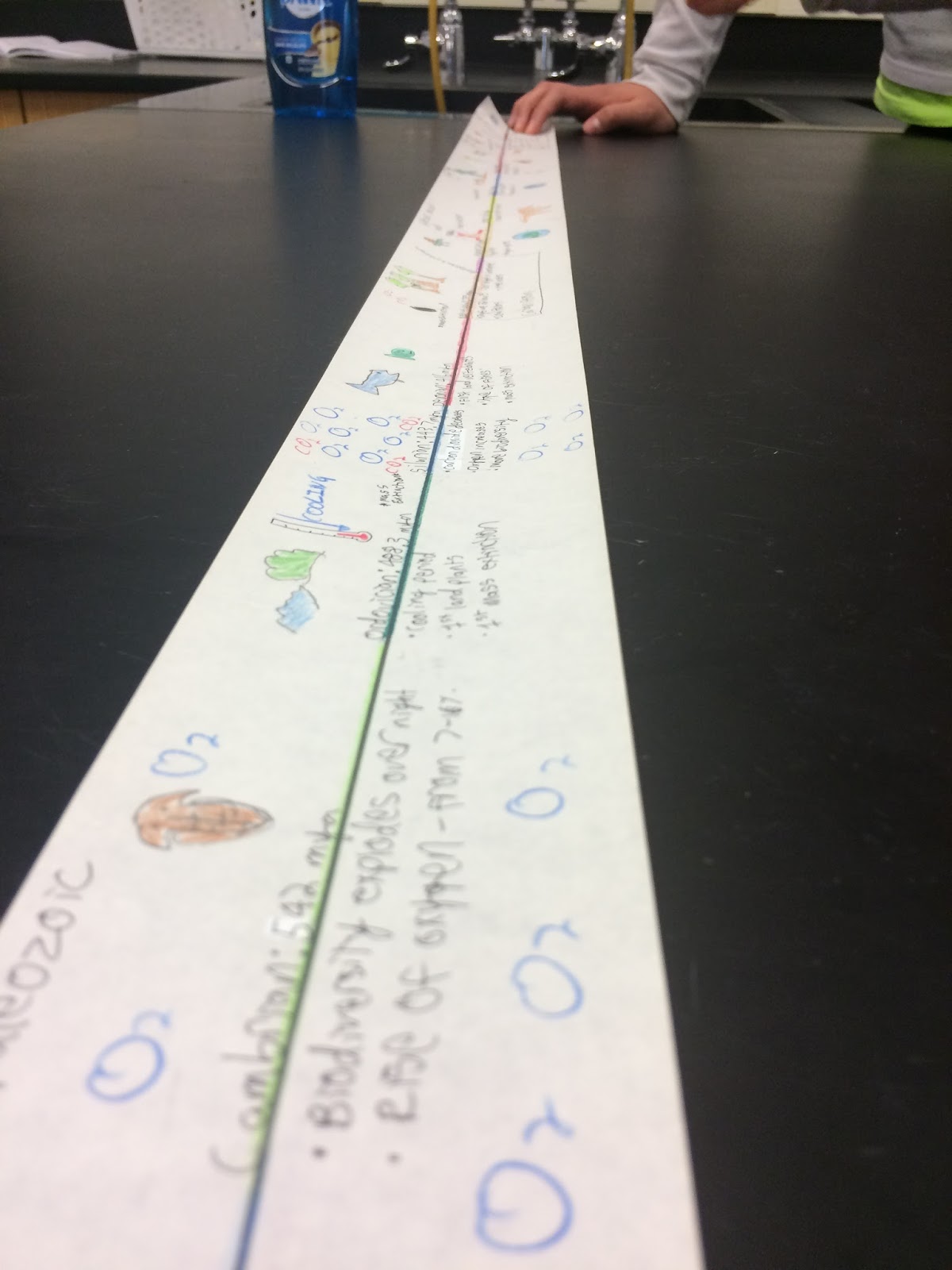
In this project, we made a geological timeline to show different events in the course of Earth. I found that there are three events in Earth's history that stood out to me the most. The first event is the diversification of vascular plants. A scientist can look at fossils to see that more plants are around but plants increase the amount of oxygen and decrease the amount of carbon dioxide in the atmosphere, making Earth more habitable. This eventually led to different mammals and eventually us, humans, living on the Earth in a suitable environment. The second event is the Permian Extinction. An extinction may seem like a bad thing, but this allows newer and fitter animals to roam the planet. Reptiles, marine, and terrestrial organisms radiate during this period while many present day insects dominate. This is a significant event in Earth's history because many of the larger animals went extinct while the smaller animals survived. This can be seen as natural selection, as I learned in Biology class. The third event is the origin of primate groups. The arrival or primate groups are important to us because it gave rise to humans. Without these primate groups existing, we may have never existed on this planet or we would have been significantly different.

During the course of this project, we discovered more and more about how long Earth has been existing. Since astronomical numbers such as light years are hard to comprehend, the Earth's scale is a little more understandable. Earth's history is can be measured with eras and periods. In the beginning eras, nothing much happened because the Earth is still taking its shape. However, as time progresses, Earth undergoes more and more events. Eventually towards the end, there are so many things happening it is hard to draw and write all the major events. The amount of events that happened towards the end of the timeline really shocked me because the events seemed like it all happened in the recent years.


During the course of this project, we discovered more and more about how long Earth has been existing. Since astronomical numbers such as light years are hard to comprehend, the Earth's scale is a little more understandable. Earth's history is can be measured with eras and periods. In the beginning eras, nothing much happened because the Earth is still taking its shape. However, as time progresses, Earth undergoes more and more events. Eventually towards the end, there are so many things happening it is hard to draw and write all the major events. The amount of events that happened towards the end of the timeline really shocked me because the events seemed like it all happened in the recent years.

The amount of progress humans have made during such a short amount of time has really left me dismayed. We have been around for such a short amount of time, yet we still find ourselves asking each other to stop and save the environment. All the mammals that lived before us managed to not destroy the Earth for a long amount of time. However, we perform such detrimental actions such as the burning of fossil fuels and throwing plastic into the ocean. We have managed to hurt the Earth so much, but we also have had many important discoveries such as writing with pencil and paper and high tech things such as the internet. All the things we use today were discovered by someone not too long ago.
I still wonder about how much longer Earth's history will be. I learned about how we are only in a blink of an eye in terms of Earth's history but I do not know how much longer it will be. I do not have an estimate because if we are only a blink of an eye, the history would be so large one could not comprehend. Also, I wonder about the different actions we perform that hurt the environment. Burning fossil fuels really hurts the environment, but I do not know how much longer we could really keep doing this and still living on Earth.
Monday, April 17, 2017
The Latest Check In - 3rd 20 Time Blog Update
After working on my 20 time project for a good amount of time already, I have learned many things about my subject. Since I am creating an experiment, I need to first gather information. I have already gathered enough information about my topic to understand what is going on. Since I am working on sleep and memory, I learned about the different sleep patterns and various beneficial ways to study and memorize concepts and words. Through the course of this project, I have learned many things about myself. Over the course of this project, I have learned that I work very productively in the amount of time in class. The classroom is silent which causes me to focus clearly on the task I am working on. Also, I have learned how creative I can be to solve various problems.
Through this project, there have been many setbacks and things that hold me back from my desired goal. The first setback I encountered is that I need to find the words, concepts, or diagrams I need to give to the people performing my experiment. Recently, I have been using random word simulators to form random words. Now, I have been moving into grasping concepts from biology. For example, this can be things we learned about evolution and photosynthesis. After I gather enough of these, I can move onto creating diagrams. These diagrams can also be from my biology vodcasts or even be other geographical maps. The main setback that has be pulling me back the most is that I need to spend a lot of time finding things for my experimental people to study and memorize. In the next class, I plan to handle this setback by gathering various things to study from my biology notebook and going online to finds various concepts and diagrams to study.
My next step in my 20 Time project would be to finding a lot of people that want to perform my experiment. Since I have finished gathering information, forming a hypothesis, and forming an experiment, I can now run my experiment. To run my experiment, I will need people to run my experiment. I can do this by asking my friends to do it. I will give them my procedures and once they finish, they can both tell me their results as well as any advice so I can run the experiment smoother.
Once I form a conclusion about the hypothesis I made, I can see what makes sense. If my hypothesis is correct about sleeping and taking a naps, then I can apply this studying habit into my own ways of studying. If this experiment proves to be beneficial, I can use this way to study during a big test or even during finals week. I can also tell my friends and peers about this and they can study more effectively.
Through this project, there have been many setbacks and things that hold me back from my desired goal. The first setback I encountered is that I need to find the words, concepts, or diagrams I need to give to the people performing my experiment. Recently, I have been using random word simulators to form random words. Now, I have been moving into grasping concepts from biology. For example, this can be things we learned about evolution and photosynthesis. After I gather enough of these, I can move onto creating diagrams. These diagrams can also be from my biology vodcasts or even be other geographical maps. The main setback that has be pulling me back the most is that I need to spend a lot of time finding things for my experimental people to study and memorize. In the next class, I plan to handle this setback by gathering various things to study from my biology notebook and going online to finds various concepts and diagrams to study.
My next step in my 20 Time project would be to finding a lot of people that want to perform my experiment. Since I have finished gathering information, forming a hypothesis, and forming an experiment, I can now run my experiment. To run my experiment, I will need people to run my experiment. I can do this by asking my friends to do it. I will give them my procedures and once they finish, they can both tell me their results as well as any advice so I can run the experiment smoother.
Once I form a conclusion about the hypothesis I made, I can see what makes sense. If my hypothesis is correct about sleeping and taking a naps, then I can apply this studying habit into my own ways of studying. If this experiment proves to be beneficial, I can use this way to study during a big test or even during finals week. I can also tell my friends and peers about this and they can study more effectively.
Monday, April 10, 2017
Unit 8 Reflection
This unit was all about populations constantly changing and evolution of populations. Some of the essential themes and understands are evolution, the role of variation in evolution, causes of change, why change occurs, what evolves, and natural selection acting on phenotypes. One of the major concepts about evolution is that natural selection acts on each individual. However, this is not the case; the whole population evolves. The natural selection acts on the phenotypes, but the genotype changes because of this. Another concept that people miss is that evolution is the change of allele frequency in a population over a period of time. Going in to this unit, I knew what evolution was but I could not have told you a solid definition. The concept of evolution can be seen by the Hunger Games Lab. This lab really helped me understand all of the concepts of evolution in a real example and this lab really cleared things up for me. The Hunger Game analysis can be viewed here.
This unit covered most concepts of evolution. However, there is not enough time to learn everything of one subject. Some things I wonder about are why evolution is evolution and why natural selection is so random. Natural selection acts on individuals but I do not understand why it acts the way it is.
In the previous unit, we learned to be more assertive. Since then, I have made efforts to try and be more assertive. One thing I have done that I found really helpful is to stand up like a hawk and not slump my shoulders like a turtle. I found this to be helpful because standing straight gives me more confidence to become more assertive. I still need to work on my voice and stating things in a more declarative tone and not in a question-like tone.
 |
| Pathwayz. Gene Pool. Digital image. Pathway. Ben Himme, Web. 10 Apr. 2017. <https://www.pathwayz.org/Tree/Plain/GENE+POOLS+%26+ALLELE+FREQUENCY> |
This unit covered most concepts of evolution. However, there is not enough time to learn everything of one subject. Some things I wonder about are why evolution is evolution and why natural selection is so random. Natural selection acts on individuals but I do not understand why it acts the way it is.
 |
| Get Holistic Health. Screaming in microphone. Digital image. Get Holistic Health. Get Holistic Health, Web. 10 Apr. 2017. <http://www.getholistichealth.com/13375/how-to-develop-assertiveness/>. |
In the previous unit, we learned to be more assertive. Since then, I have made efforts to try and be more assertive. One thing I have done that I found really helpful is to stand up like a hawk and not slump my shoulders like a turtle. I found this to be helpful because standing straight gives me more confidence to become more assertive. I still need to work on my voice and stating things in a more declarative tone and not in a question-like tone.
Wednesday, March 29, 2017
Hunger Games Final Analysis Answers
- In this Hunger Games lab, each student was assigned a different way to eat corks. There was a stumpy's that had to eat food with wrists, knuckler's that had to eat food with knuckles, and pincher's who had to eat with their index finger and thumb. The class went outside to the lower field and all stood with their backs to the center and once Mr. Orre blew the whistle, the class would turn around and try to eat as many corks as possible. After a certain amount of time, he would tell us to stop and count of corks. If we did not have more than a certain amount, we could not reproduce and died off. This lab stimulated a real life situation of different kinds of animals fighting for survival. It also demonstrated natural selection because most of the pincher's survived because they were better suited for survival.
- The pincher's phenotype of aa was the best for survival. The pincher's were best suited for survival because the way that they ate was the most efficient. Instead of picking up one at a time with their wrists, pincher's could grab two at a time with far more accuracy with their fingers.
- Throughout this lab, the population did evolve and this can be seen with the evidence that I collected. At the beginning of the lab, the ratio of "A" alleles to "a" alleles were 0.48 to 0.52, respectively. At the end of the lab, the ratio of "A" alleles to "a" alleles changed to 0.18 to 0.82, respectively. The population did evolve because the ratio of the different alleles changed.
- Some random factors in this lab were the assignment of alleles at the start, who stood where in the circle to get food, who was the child of which family, and sometimes the placement of the food. However, some factors were not random and were done on purpose. The factors in this lab that are done on purpose are the mating of two individuals and where Mr. Orre decided the place the food in the later generations. If Mr. Orre decided to put all the food next to the pincher's, the whole population would turn into pincher's fairly quickly. However, if he decided to help out the stumpy's and put the food right next to all the stumpy's, the stumpy's would have a higher chance of survival and would last a little longer in the population.
- If the food was a different size, the population would have changed. If the food was too big for a pincher to pinch, the pincher's would not do as well as the stumpy's because they use their wrists not delicate and precise fingers to grab things. If the food was smaller, than the pincher's would be favored because they have precise movements and can pick up smaller items easier.
- If there was no incomplete dominance, then the knuckler's would have not existed and the population would only be pincher's and stumpy's. The results would have changed because the ratio of alleles would have been far more towards one species and in this case would be the pincher's.
- Natural selection acts on the population causing the weaker traits to die out and stronger traits to be common. Over long periods of time, the population would evolve because the population needs to adapt to their environment.
- Since pincher's provided to be dominant, pincher's commonly got together to mate and produce another pincher baby. However, later on in the lab, there were only a few stumpy's and knucklers. The stumpy's bred with stumpy's, making more stumpy babies, which make the ratio of stumpy's in the population higher. If pincher's mated with only pincher's, the whole and most of the population would be pincher's. In nature, to ensure survival, same species mate with each other because they want their species to not die out and become extinct.
- In evolution, a population evolves. The population would change in order to adapt to what the environment provides. Natural selection acts on the phenotype. The genotype changes which causes the phenotype to change.
- After this lab clearly demonstrated evolution and natural selection, I had a clear understanding of how these concepts work and this lab answered all my questions.

Subscribe to:
Posts (Atom)